Model Release
Google Releases Gemma 4 Open Models
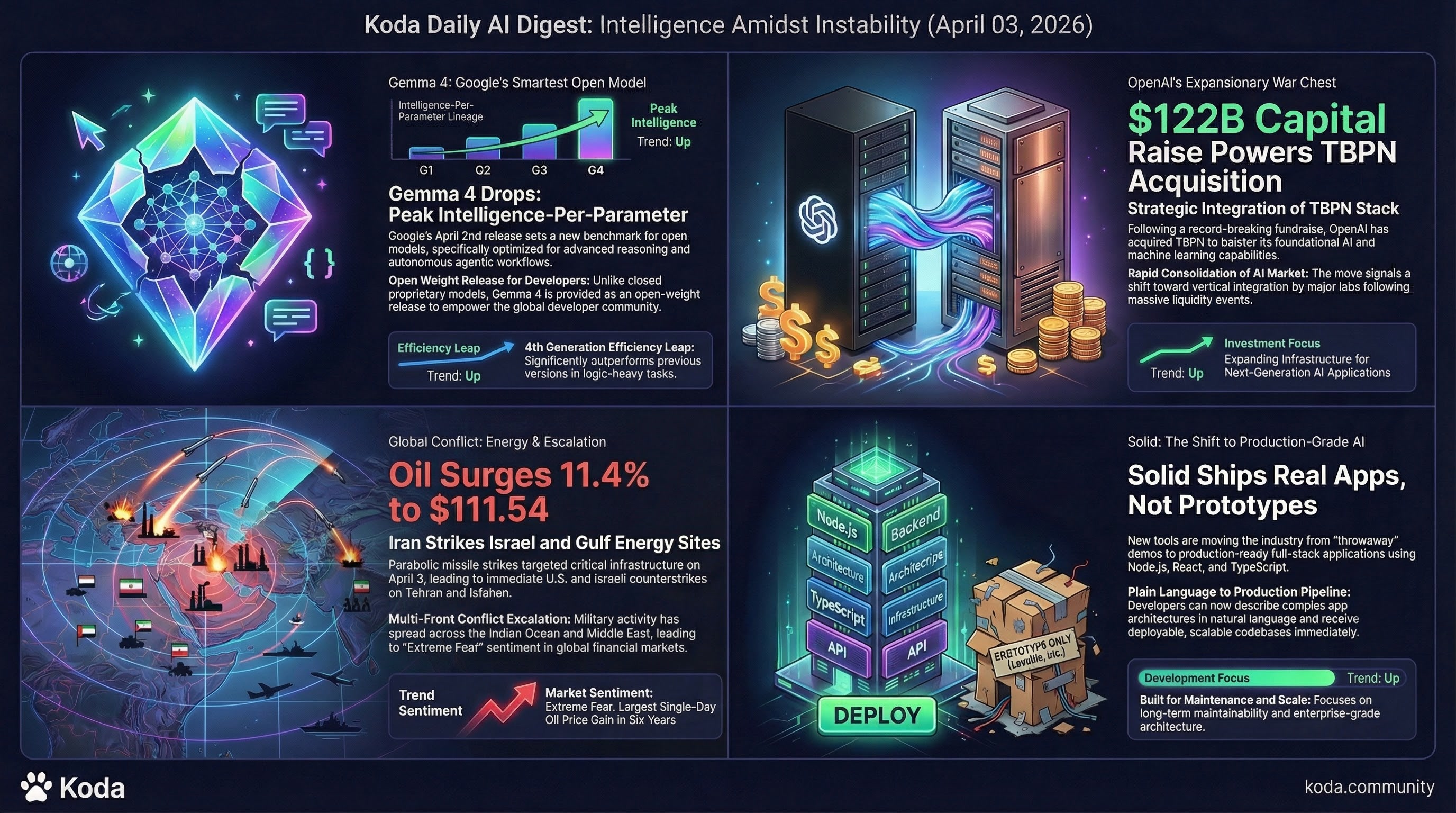
Google launched Gemma 4 on April 2, 2026, calling it the most intelligent open model family it has produced. The release emphasizes advanced reasoning and agentic workflows with what Google describes as unprecedented intelligence-per-parameter efficiency. Hugging Face quickly stood up a Gemma 4 Playground on Spaces with ZeroGPU access, signaling immediate community adoption. Source →
Enterprise
OpenAI Acquires TBPN in Expansion Push
OpenAI announced it has successfully acquired TBPN, a deal the company says will enhance its capabilities in AI and machine learning applications. Details on TBPN's technology stack and deal terms have not been disclosed. The acquisition follows OpenAI's record $122 billion fundraise and signals continued aggressive expansion beyond model development. Source →
Enterprise
Codex Gets Pay-as-You-Go Team Pricing
OpenAI introduced flexible, usage-based pricing for its Codex coding platform, replacing fixed-tier plans for teams. The pay-as-you-go model is designed to lower the barrier for smaller developer teams and organizations that do not need always-on capacity. No specific per-token or per-request rates were disclosed in the announcement. Source →
Trend
April Prediction Markets Show Crowded Pipeline
Manifold prediction markets now price Gemma 4 at 98.8% resolved for April, with five other models above 55%: MiniMax M3 (65%), Kimi K3 (63%), GPT-5.5 or variant (62%), DeepSeek V4 (58%), and Gemini 3.1 Flash (57%). Claude variants trail at 27% to 35%, while GPT-6 sits at just 10%. The data suggests April could rival March's nine-model output. Source →
Open Source
Hugging Face Ships TRL v1.0 Training Library
Hugging Face released TRL v1.0, marking a major overhaul of its post-training library for large language models. The team described the release as a shift from research codebase to production-grade library, built to keep pace with rapidly evolving fine-tuning and alignment techniques. TRL supports reinforcement learning from human feedback and related post-training workflows. Source →
Benchmark
GPT-5.4 Matched Gemini 3.1 Pro at Top
A detailed March retrospective from WhatLLM confirmed GPT-5.4 (xhigh) scored 57.17 on the Intelligence Index, just 0.01 points behind Gemini 3.1 Pro Preview's 57.18. The report noted nine text models shipped in March, seven of them open-weight, with three using mixture-of-experts architectures. The near-tie at the top received surprisingly little industry attention. Source →
Policy
Pentagon Labels Anthropic a Supply-Chain Risk
Multiple U.S. agencies began phasing out Claude models over a six-month transition after Anthropic refused to loosen restrictions on autonomous weapons use, according to WhatLLM's March roundup. Anthropic received a "supply-chain risk" designation, a label normally reserved for foreign adversaries. OpenAI moved quickly to secure a new Department of Defense agreement in the wake of the decision. Source →
Enterprise
Coder Raises $90M Series C From KKR
Coder, the enterprise development environment platform, closed a $90 million Series C round led by KKR to advance secure enterprise AI development. The funding reflects growing investor appetite for infrastructure that governs how developers interact with AI coding tools inside corporate environments. No valuation was disclosed. Source →
Open Source
March Shipped Seven Open-Weight Models in One Month
Of the nine text models released in March 2026, seven were open-weight, continuing a decisive shift toward accessible model distribution. Alibaba's Qwen 3.5 series spanned 0.8B to 397B parameters across multiple MoE configurations, while the large variant scored 45 on the Intelligence Index. The open-weight dominance is reshaping the competitive landscape from the middle of the leaderboard upward. Source →
Hardware
NVIDIA Nemotron Coalition Backs Open Frontier Models
At GTC 2026 in mid-March, NVIDIA announced the Nemotron Coalition with partners including Mistral, Perplexity, and Cursor to develop open frontier models. Jensen Huang also revealed over $1 trillion in infrastructure orders in the pipeline and debuted the Vera Rubin AI platform, which claims roughly 10x training cost reduction for trillion-parameter models. New dedicated inference chips and an open Agent Toolkit were also unveiled. Source →