S&P 5007,444.25↑ 0.58%
NASDAQ26,402.34↑ 1.20%
BTC$79,315.87↑ 0.03%
ETH$2,255.15↓ 0.12%
OIL$100+↑ BLOCKADE
SUMMITMAY 15· ONGOING
SIGNAL PLAN$1/mo· LAUNCH
Lead Story
Enterprise
OpenAI
OpenAI published a detailed account of its response to the recent TanStack npm supply chain attack, outlining proactive security measures and reinforced protocols for its developer tooling. The disclosure reflects growing concern about software supply chain vulnerabilities in AI-adjacent...
Continue Reading
AI
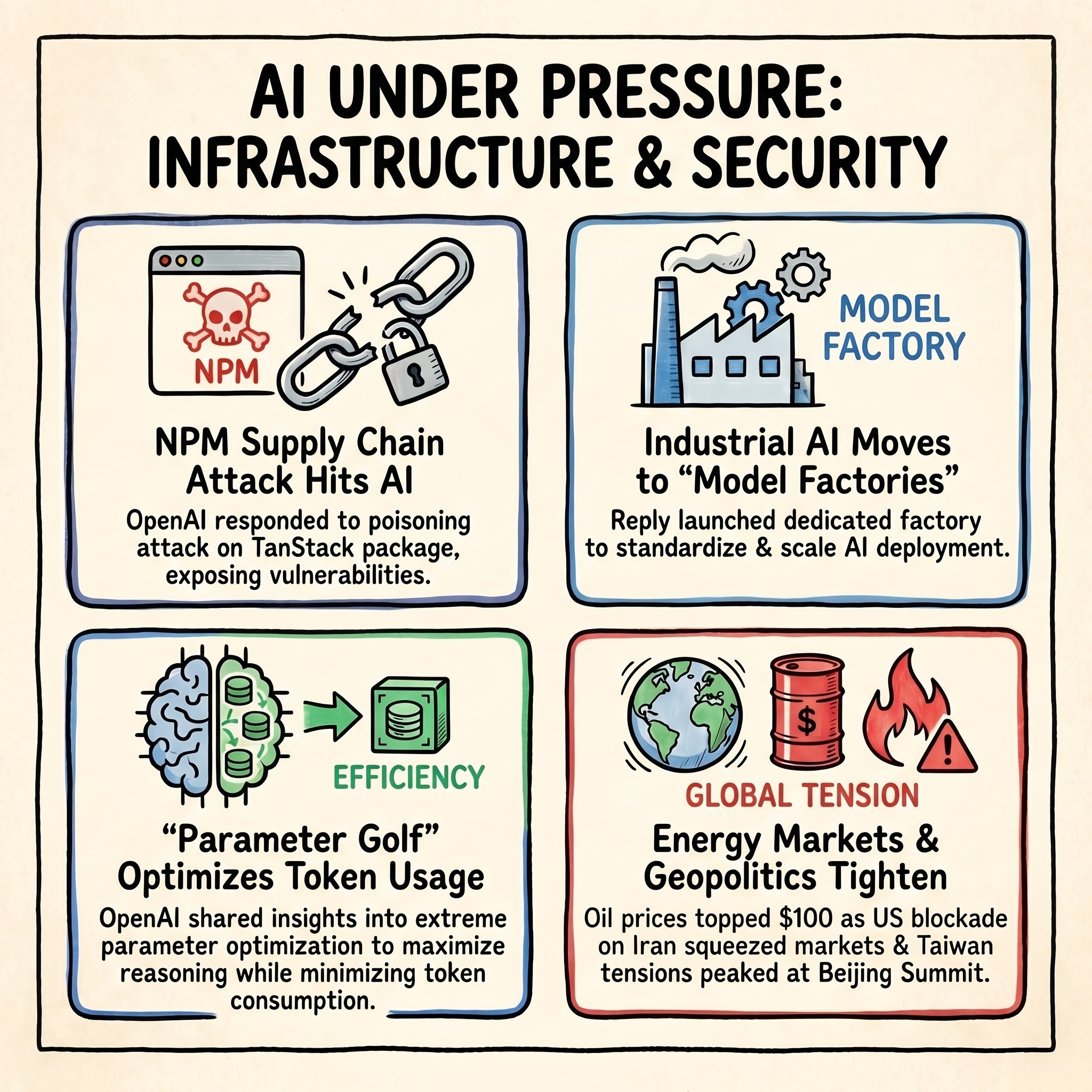
OpenAI responded to a supply chain attack targeting TanStack's npm packages, highlighting how AI-generated code dependencies are becoming prime vectors for software compromise.
World
Xi Jinping delivered a direct warning to President Trump on Taiwan during their Beijing summit, raising the temperature on the most consequential bilateral relationship in geopolitics.
Markets
Fear dominates sentiment as oil breaches $100 on the US blockade of Iran, compounding uncertainty from geopolitical flashpoints in both Asia and the Middle East.
Wild Card
Token-based pricing metrics are quietly warping how engineers build AI systems, incentivizing verbose outputs and architectural bloat over genuine performance gains.
Bitcoin
$$79,315.87
+0.03%
Today's Focus
01
npm Attack Hits AI Toolchains
A supply chain attack on TanStack's npm packages forced OpenAI to issue a public response, underscoring how deeply AI development depends on open-source JavaScript infrastructure. The incident is a reminder that the weakest link in frontier AI is often a community-maintained package, not the model itself. Expect renewed pressure on AI companies to audit and lock down their dependency trees.
02
Perverse Incentives in Token Economics
AI token metrics, the standard unit for pricing and benchmarking model usage, are creating engineering incentives that reward verbosity over efficiency. Teams optimizing for token throughput may inadvertently degrade user experience and inflate costs. This structural misalignment could slow enterprise adoption if pricing models are not reformed to reward outcome quality.
03
Industrial AI Gets a Factory
Reply's launch of Model Factory signals a maturing market for deploying AI in industrial settings, moving beyond pilot projects into repeatable, scalable production workflows. The platform aims to standardize how manufacturers train, validate, and deploy domain-specific models. Combined with Neurovia AI's new NeuroStream visual data platform, the week marks a clear pivot toward operational AI infrastructure rather than research novelty.
Podcast
~22 min

Infographic
Intelligence Map
Newsletter Intelligence
14 May 2026
- •Spotify streams generate 1.5X more listening time than YouTube views
- •Media channels are blurring: 'What is TV?' becomes a real question for marketers
- •Expressive sales delivery increases purchase intent by 35.8%
Read TLDR →
14 May 2026
- •Tokenmaxxing and misaligned incentives: AI token usage metrics create perverse incentives for engineers
- •Wasp co-founder calls inventing a new web programming language a $5M mistake after 5 years
- •QuestDB achieves up to 25x performance gains with parallelized, SIMD-vectorized WINDOW JOIN operator
Read TLDR →
14 May 2026
- •Apple is working to incorporate AI agents into the App Store while maintaining privacy and security standards
- •Amazon ditches Rufus chatbot, launches Alexa Shopping agent in AI strategy pivot
- •Fervo Energy raises $1.89 billion in IPO to make geothermal energy mainstream
Read TLDR →
14 May 2026
- •DuckDB Goes Remote with New Quack Client-Server Protocol over HTTP
- •When Lakehouse Statistics Fail, Query Engines Get Lost
- •Netflix Tames Data Governance at Scale with Data Projects
Read TLDR →
14 May 2026
- •Anthropic seizes OpenAI's business AI lead for the first time, per Ramp AI Index
- •Amazon doubles down on Alexa+ for shopping
- •Adaption launches AutoScientist to automate AI training
Read The Rundown AI →
14 May 2026
- •Fast mode for Claude Opus 4.7 is now available in research preview across the API, Claude Code, Cursor, Emergent, Factory, v0, Warp, and Windsurf, with plans to become the default mode.
- •Meta is releasing its Muse Spark foundational model to power Meta AI services, enabling faster voice responses, smarter shopping assistance, and real-time visual recognition through device cameras for users in the US and Canada.
- •Google and SpaceX are reportedly in discussions about building orbital data centers in space as part of broader efforts to expand AI compute infrastructure beyond Earth-based facilities.
Read TLDR →
Forward this to one operator you work with. Your referral link is in every email; milestones at koda.community/refer.