The Lab · Coding
Herdr
Desktop workspace that keeps Claude Code and Codex sessions alive in the background
Close the Herdr window on a test-suite refactor and a dependency upgrade, and both agents keep working until you open it again.
The verdict
Herdr's server owns your agent processes, so quitting the app leaves Claude Code and Codex running until you return. Anyone juggling several CLI agents on one machine should install it today; adoption costs a download and one click on the + button. Treat it as a keeper of live sessions and keep reading the output yourself, because its reporting on unattended work is thin.
- Good for
- Developers running several CLI agents; Longtime tmux users; SSH-heavy workflows
- Skip it if
- Teams that need agent spend budgets; Intel Mac owners
- Costs
- No price found1
What it does
As Herdr describes it.1
- Sessions that outlive the window
- A background server owns the agent processes, so you can detach or quit the app and come back to the same running agents.
- Agent tabs
- Start Claude Code, Codex or any other program from the + in the tab bar.
- Split panes and session overview
- Split panes plus an overview of every session let you watch all your agents from one window.
- Spot the agent that needs you
- Josh Finnie writes that he no longer tabs through six panes hunting for the one waiting on him.
- Agent-editable workspace
- Herdr ships a guide describing its own configuration, so you can ask your agent to build a board or add a timer to each tab.
- Shared layouts
- A layouts gallery lets you install a workspace someone else already built.
- Native terminal rendering
- It is built on libghostty, which a Hacker News commenter credits for avoiding a terminal nested inside another terminal.
- Plugins
- Add-ons such as herdr-reviewr extend the workspace, per Josh Finnie's setup write-up.
Ways to put it to work
Overnight split shift · for the solo developer with two agents
Give a Codex tab the dependency upgrade and a Claude Code tab the test-suite refactor, quit the app, and review both diffs the next morning.
You get: Two long jobs finish on one machine without you babysitting either terminal.
Kill-the-window test · for the tmux or cmux user weighing a switch
Run a dev server and an agent inside Herdr, quit the app, reopen it, and check whether both processes are still the originals. Flavio Copes notes cmux brings a dev server back as a fresh shell after restart.
You get: A five-step proof of whether Herdr's persistence beats the layout restore you have today.
Quiet means unverified · for the lead delegating unattended runs
Adopt a rule: any tab that went silent counts as unfinished until someone has read its scrollback, and only then does its branch get merged.
You get: Stalled agents stop slipping half-done work into main.
What it costs
No price found1
Our take: Without a printed price there is nothing to weigh yet, so value stays unscored.
What people say
Early and warm: Reddit and Hacker News users praise its polish and persistent sessions, while one detailed code review flags weak reporting for unattended runs.
Calls Herdr fantastic, saying it fixed both their windows-lost-on-reboot problem and the hassle of frequently working over SSH.
Rates it by far the most polished tool in its category, very stable and well thought out, though they noticed LLM-isms in the landing-page copy.
Where it falls short
- A Reddit reviewer reading the code reports that an agent which stops producing output may be treated the same as one that finished.
- There is no summary of what happened while you were away, so catching up means scrolling back through each pane.
- The Mac download targets Apple silicon and the Windows build is x86_64 only.
- Even an enthusiastic Hacker News commenter concedes some workflows need nontrivial workarounds.
Your first hour
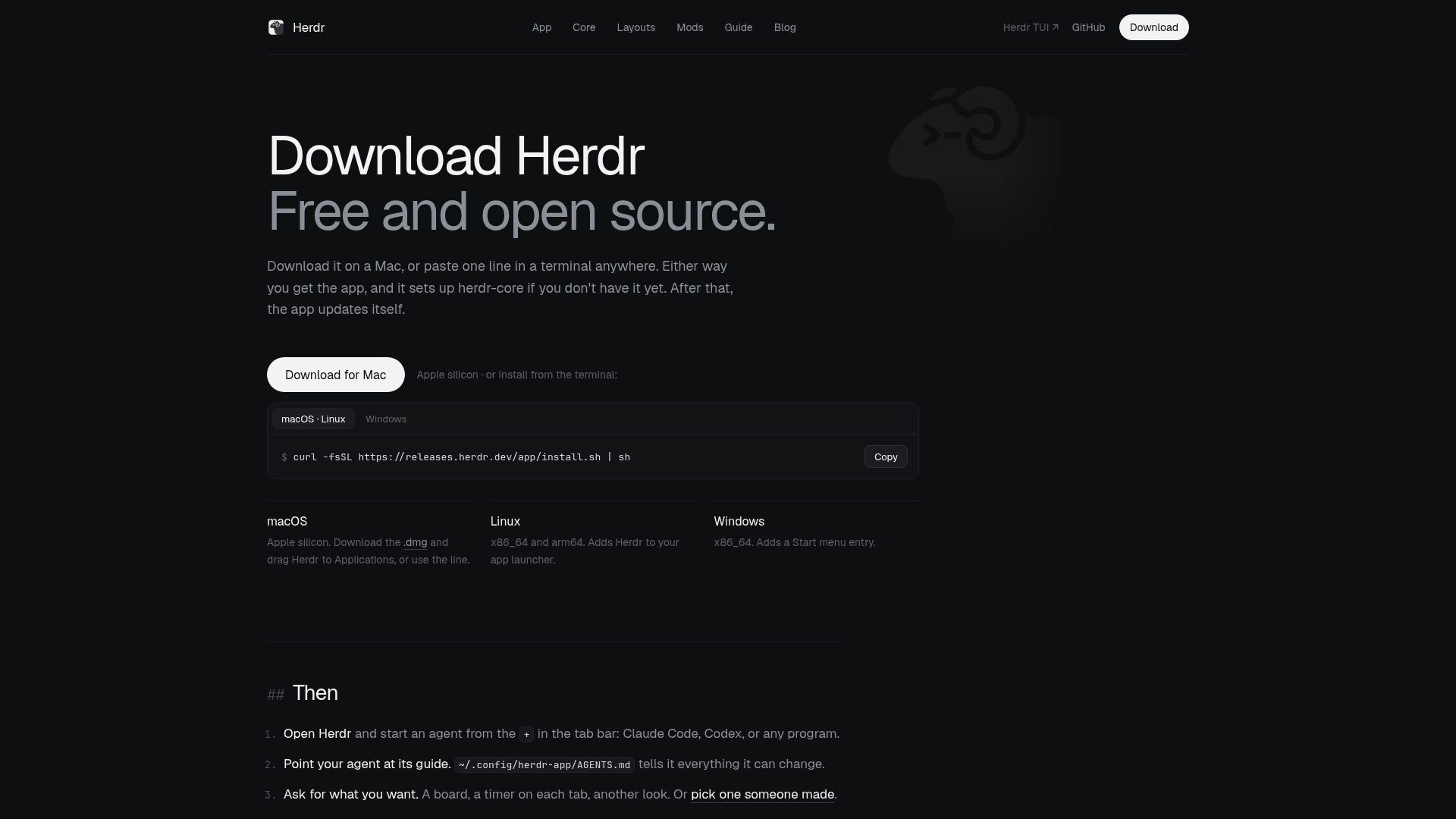
- On an Apple silicon Mac, drag the .dmg to Applications; on macOS or Linux you can run the curl install script, and on Windows the PowerShell line.
- Open Herdr and start an agent from the + in the tab bar.
- Point the agent at ~/.config/herdr-app/AGENTS.md so it knows what it is allowed to change.
- Ask for the layout you want, or pick one from the layouts gallery.
If it isn't the fit
cmux4 · A terminal application that restores your layout and resumes supported agents after a restart.
Pick it when you want the terminal app itself and can live with dev servers coming back as fresh shells.
OpenHands5 · A broader agent control center that runs agents across local, remote and cloud backends.
Pick it when your agents need to run on remote or cloud machines as well as your laptop.
The Lab reviewed OpenHands 1.28.1 on 2026-10-21Questions
- Is Herdr free to try?
- The download page lets you install it straight away with no sign-up or checkout step shown. The pages Koda read listed no price for any plan.
- Can I run it on a server without the desktop app?
- Yes. The download page points to herdr-core, the runtime on its own, meant for servers or for building your own client.
The call
Herdr earns a place on any multi-agent workstation now; revisit its status reporting before you hand it the overnight shift.
How we scored it
Four scores out of 10, weighted and added. The weights are the same for every tool.
Capability7.0 × 46.7% = 3.27
Persistent server-owned sessions, agent-editable layouts and plugins cover the core job well, though it gives you little insight into what an agent did while unattended. What it does
Ease of use7.5 × 26.7% = 2.00
A .dmg drag or a single install line gets it on the machine, and the first agent starts from the + in the tab bar. Your first hour
ValueNot scored, carries no weight
Not scored: the pages this review read showed no paid price, so the Koda Score is weighted over capability, ease and momentum. What it costs
Momentum5.5 × 26.7% = 1.47
A Hacker News thread on Herdr joining Y Combinator and several enthusiastic Reddit threads show real energy, but no dated release, star count or funding month is on record, so momentum stays under the cap.7
Koda score6.7
The parts add to 6.73, rounded half up to one decimal.
Sources
- 1Herdr · herdr.dev, read 3 November 2026: prices, capabilitiesReported
- 2Reddit r/ClaudeCode · reddit.com, read 3 November 2026: the reviewer paraphrased under What people sayReported
- 3Hacker News · news.ycombinator.com, read 3 November 2026: the reviewer paraphrased under What people sayReported
- 4cmux · flaviocopes.com, read 3 November 2026: what it isReported
- 5OpenHands · opensourcealternatives.to, read 3 November 2026: what it isReported
- 6Amp · vibecodes.net, read 3 November 2026: what it isReported
- 7news.ycombinator.com · read 3 November 2026: momentum evidenceReported
Also read, not quoted: Hacker News, Reddit r/ClaudeCode, flaviocopes.com.
How this review was made
We read 4 pages of herdr.dev, ran 3 searches and read 7 community posts. Prices and product claims are reported as their source published them. The four scores are the Koda Lab's judgement; per-user prices and the total are our math.
How we scoreCorrectionsLAB REPORT 269