The Lab · Coding
Kiro Bots
Persistent, permissioned AI agents in Kiro Crew that take on recurring dev work
AWS is pitching Kiro Bots as agents you can stop babysitting, which makes the smart first move, watching them closely, a little ironic.
The verdict
Kiro Bots turn a one-off coding agent into a named worker inside Kiro Crew that keeps project memory between sessions and can direct other agents. The design is sound and the entry cost is low, yet the evidence so far is launch coverage, so adoption should start as a scoped trial. Teams sitting on a dull, repeating chore like dependency bumps are the right first customers.
- Good for
- Teams with recurring maintenance chores; Kiro users on spec-driven workflows
- Skip it if
- Buyers who want peer reviews first; Teams locked into another agent platform
- Costs
- Free tier, paid from $20/mo1
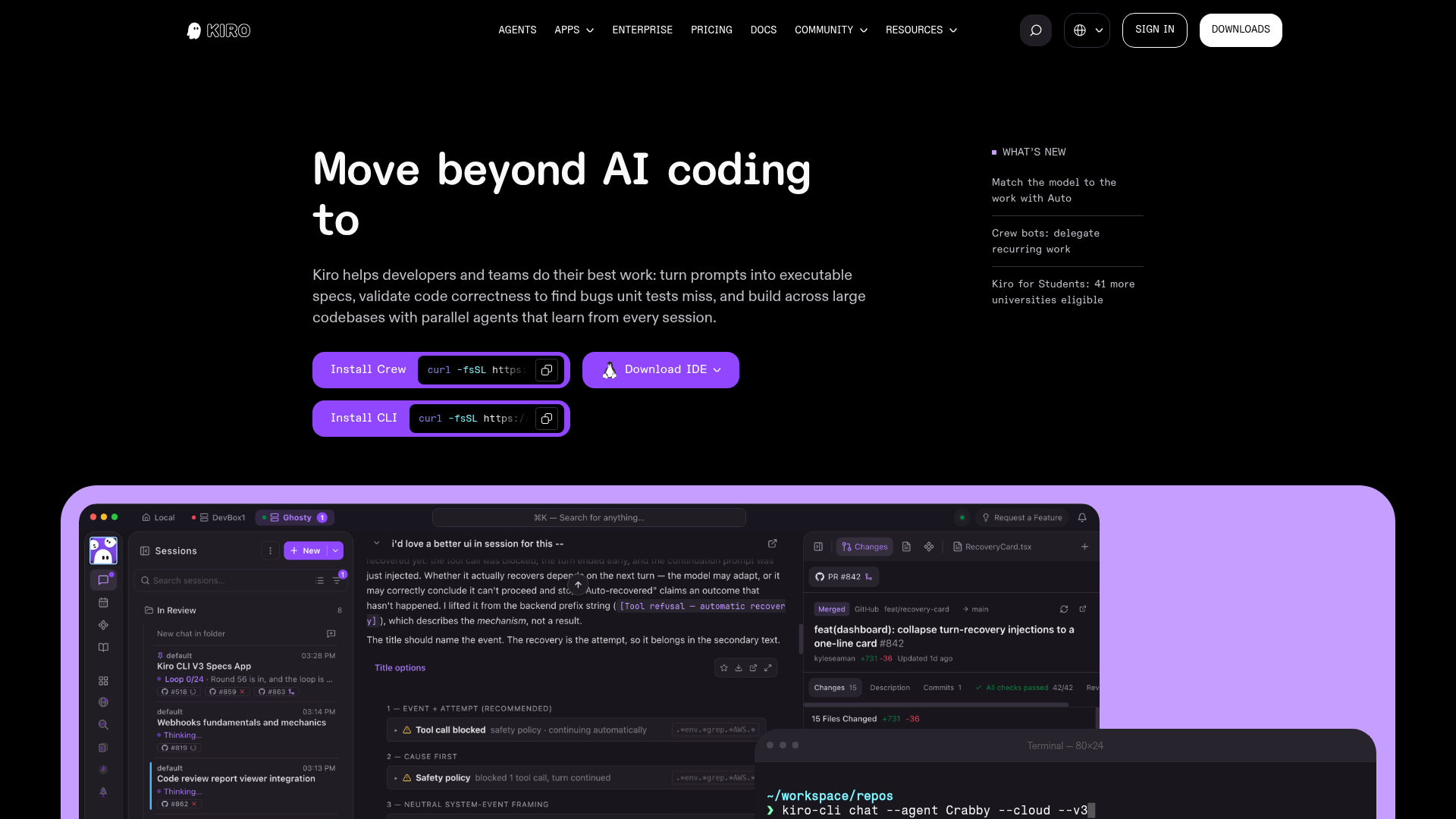
What it does
As Kiro Bots describes it.1
- Persistent project memory
- Each bot keeps what it learned about your project between sessions, so a weekly job does not start cold.
- Agent coordination
- A bot can direct other agents in Kiro Crew to split up a larger piece of work.
- Recurring responsibilities
- Bots can own scheduled engineering chores such as a dependency check or a codebase cleanup pass.
- Narrow permissions per bot
- The AI Economy describes each bot as carrying a limited permission set tied to its job.
- Cloud CLI sessions
- The kiro-cli chat command takes an --agent name and a --cloud flag to run a named agent remotely.
- Spec-driven development
- Kiro builds work around specifications and requirements, with automated testing and validation.
Ways to put it to work
Dependency check trial · for the maintainer of a single service repo
Schedule one bot to run a weekly dependency check and open a pull request, then read its stored project memory after every run for a few weeks.
You get: Proof of whether the bot's memory stays accurate before it touches anything larger.
Scope promotion rule · for the engineering lead approving bot permissions
Keep each bot on one responsibility until its recent outputs merge without rework; only then add a cleanup pass to its duties.
You get: A written bar for widening a bot's reach that the whole team can apply.
What it costs
| Plan | Price | Includes |
|---|---|---|
| Free | $0/mo | 50 credits, per VentureBeat |
| ProOur pick | $20/mo | 1,000 credits, per VentureBeat |
| Higher individual tier | $40/mo | Credit allowance not shown |
| Higher individual tier | $100/mo | Allowance not listed |
Prices from kiro.dev on 7 November 2026.1
Our take: Pro is the sensible tier for a one-bot trial, since its allowance should leave room for several weekly cycles as long as per-run credit use stays modest.
Our math, per 1,000 credits, from the prices above:
- Free: Free for 50 credits.
- Pro: $20.00 per 1,000 credits ($20 for 1,000).
What people say
Kiro Bots launched too recently for any attributable developer praise or complaint to surface; coverage so far is press and launch write-ups.
Where it falls short
- The per-run credit cost of a scheduled bot was not visible on the pages read, so monthly spend is hard to forecast.
- Kiro warns that performance may vary with task complexity, which matters for a bot running unattended.
- Memory quality is something you audit yourself during the early runs.
- Bots live inside Kiro Crew, so a team standardized on another agent platform takes on a second tool.
Your first hour
- Create a Kiro account on the Free plan.
- Open Kiro Crew and set up a bot with a name and a narrow job.
- Connect the repository it should work on through the GitHub or GitLab integration.
- Assign one scheduled chore and inspect the first pull request it produces.
If it isn't the fit
Claude Code2 · Anthropic's terminal and IDE coding agent built around direct agent workflows.
Pick it when you want an agent to code alongside you without writing specs first.
OpenAI Codex3 · OpenAI's coding agent for delegated tasks across terminal, desktop and ChatGPT.
Pick it when your team already hands work off inside ChatGPT.
The Lab reviewed OpenAI on 2026-10-04Questions
- Can I try Kiro Bots without paying?
- Kiro's site lists access to Kiro Crew on its Free plan, and Crew is where Bots live. The free credit allowance VentureBeat reports is small, so a job that runs every week may push you to a paid plan quickly.
- Does Kiro work offline?
- Kiro's site says some features have no offline functionality. Plan on a network connection for any bot that runs as a cloud session.
The call
Give Kiro Bots something boring and checkable this week, and hand over more of the repo only once the track record earns it.
How we scored it
Four scores out of 10, weighted and added. The weights are the same for every tool.
Capability7.0 × 35% = 2.45
Persistent memory plus agent coordination matches what recurring agents from rival vendors promise, though no published run shows the quality of the output. What it does
Ease of use6.5 × 20% = 1.30
A free plan with Crew access and a CLI that starts cloud sessions make the first bot quick to stand up, though Kiro states no time to value. Your first hour
Value7.0 × 25% = 1.75
VentureBeat's figures put the paid entry point low for a credit allowance that can cover a weekly chore, but the credit cost of one bot run is unknown. What it costs
Momentum5.5 × 20% = 1.10
The AI Economy covered the launch on 5 Nov. 2026 and VentureBeat ran a head-to-head comparison, but no dated release count or repository figure from AWS is on record, so momentum stays capped.5
Koda score6.6
The parts add to 6.60, rounded half up to one decimal.
Sources
- 1Kiro Bots · kiro.dev, read 7 November 2026: prices, capabilitiesReported
- 2Claude Code · anthropic.com, read 7 November 2026: what it isReported
- 3OpenAI Codex · openai.com, read 7 November 2026: what it isReported
- 4Cursor · cursor.com, read 7 November 2026: what it isReported
- 5theaieconomy.substack.com · read 7 November 2026: momentum evidenceReported
Also read, not quoted: venturebeat.com, theaieconomy.substack.com, shashi.co, facebook.com, dreamjtech.com.
How this review was made
We read 2 pages of kiro.dev, ran 3 searches and read 5 community posts. Prices were captured on 7 November 2026. Prices and product claims are reported as their source published them. The four scores are the Koda Lab's judgement; per-user prices and the total are our math.
How we scoreCorrectionsLAB REPORT 273