The Lab · Coding
SoreQen Code
Open-source coding agent that runs your tests and checks its output in a browser
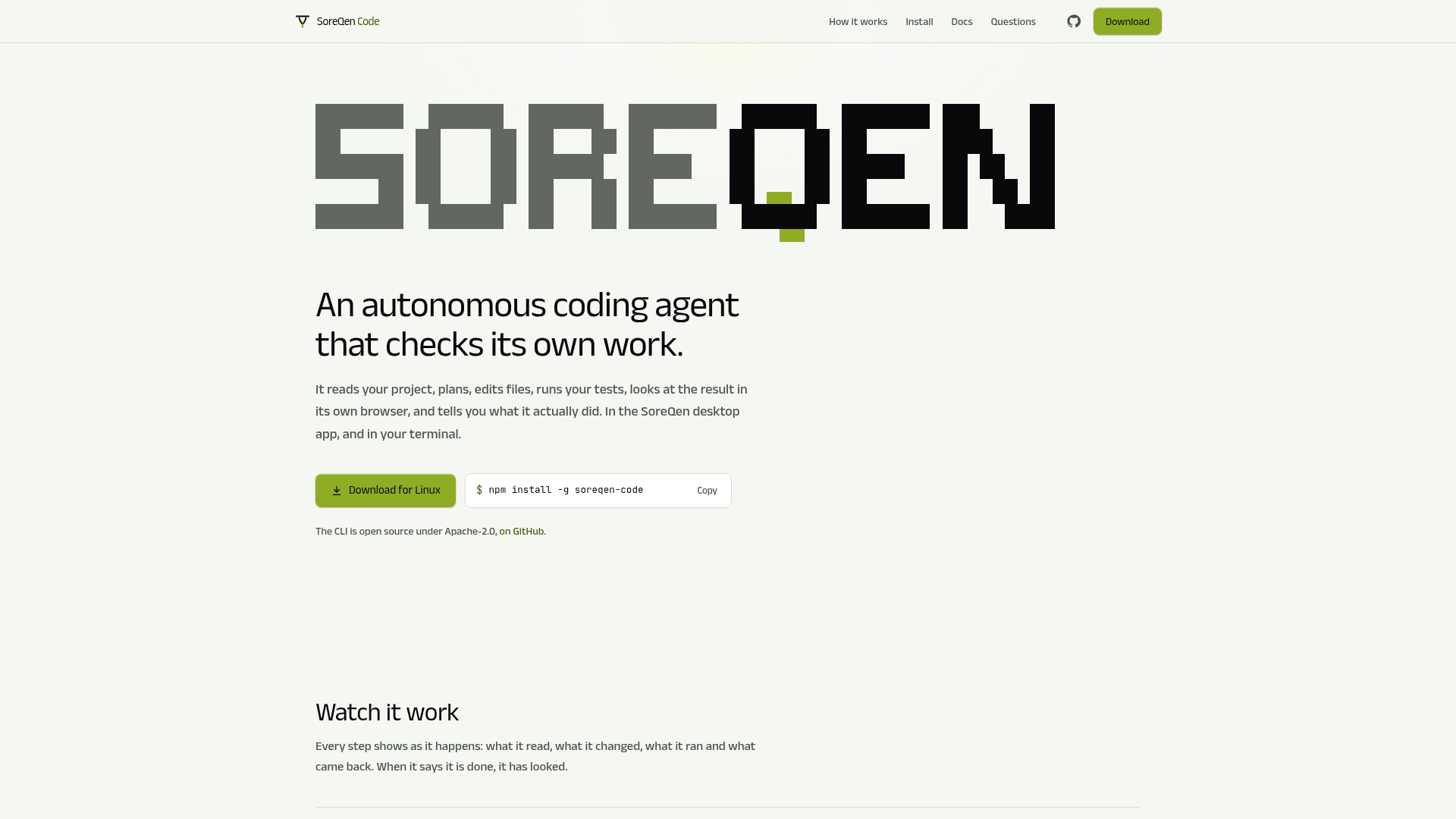
SoreQen Code ends every turn by showing what it ran and what came back, including screenshots from its own browser, which makes its biggest claim unusually easy to check.
The verdict
The pitch is an agent whose 'done' means it looked: it runs your tests, checks the page in its own browser and reports what it could not verify. That is the right instinct for autonomous coding, and the open-source CLI costs nothing to try on your own API key. The release is days old, though, and no outside user has yet shown whether the checks hold up, so developers curious about verification-first agents should trial it on a side project while teams with production repos wait for evidence.
- Good for
- Developers testing verification-first agents; Solo builders on their own API keys; Open-source tinkerers who read the code
- Skip it if
- Teams putting agents on production repos today; Anyone wanting a browser-based agent
- Costs
- Free tier, paid from $8/mo1
What it does
As SoreQen Code describes it.2
- Plan and test loop
- Writes a plan it keeps current as it works, then runs your project's existing tests before reporting.
- Browser self-check
- Opens the built page in its own browser at chosen widths and fixes visible problems, such as a cut-off button, before it reports.
- Turn-level rewind
- /rewind undoes any turn and puts files back as they were, and Auto mode checkpoints the project before making changes.
- Goal mode
- /goal keeps the agent working turn after turn until an objective is achieved and verified.
- Project memory
- /memory keeps notes between sessions on how a project runs and how you like things done.
- Skills and MCP tools
- Ships 36 built-in skills, extendable with your own SKILL.md files, and a project's MCP servers start only after you allow them.
- Headless runs
- soreqen --print runs one task with no prompt and returns an exit code that says how it ended, handy in scripts.
- Model choice
- Switches between hosted SoreQen models and your own provider keys, including local models in Ollama or LM Studio, from /model.
Ways to put it to work
Honesty audit · for the developer evaluating coding agents
Plant a known failing test on a throwaway branch, run soreqen --print "fix the failing test", and compare its turn report and exit code with what CI says.
You get: Hard evidence of whether its claimed passes match reality before it touches real work.
Viewport-checked UI tickets · for the frontend developer
Write the viewport into the prompt, for example 'check it at phone width', and read the screenshot steps in the log before merging.
You get: Layout breakage that unit tests pass over gets flagged during review.
Upgrade trigger · for the budget-minded solo builder
Stay on the Free account with your own key until its turn reports have matched CI on several real tickets; only then price a plan against what soreqen usage shows you burning.
You get: No subscription spend until the core promise has earned it on your own code.
What it costs
| Plan | Price | Includes |
|---|---|---|
| Free | $0/mo | 1,200 credits a month for the Flow models, signed in; SoreQen S1 Mini and S1; no card required |
| PlusOur pick | $8/mo | 14,000 credits a month; every SoreQen model including S1 Mega; $6.80 a month billed annually |
| Pro | $20/mo | 32,000 credits a month; priority access at busy times; $17 a month billed annually |
| Elite | $100/mo | 176,000 credits a month; the highest 5-hour and weekly limits; $85 a month billed annually |
Prices from soreqen.com on 21 November 2026.1
Our take: Plus is the tier to weigh, since $8 a month is cheap enough to learn whether hosted Flow models do better in the agent loop than the keys you already own.
Our math, per 1,000 credits, from the prices above:
- Free: Free for 1,200 credits.
- Plus: $0.57 per 1,000 credits ($8 for 14,000). Pro costs no less per credit.
- Pro: $0.63 per 1,000 credits ($20 for 32,000).
- Elite: $0.57 per 1,000 credits ($100 for 176,000).
What people say
SoreQen Code is too new for a street verdict: AlternativeTo lists no reviews, and the only reactions are Product Hunt comments mixing interest in its checkpoints with pointed questions about failure handling.
Being able to approve steps remotely while the agent keeps running fixes the familiar problem of finding out an hour later that a long build got stuck.
Where it falls short
- The self-verification claims rest on vendor demos and maker replies; no independent user has documented a success or failure yet.
- The CLI requires Node.js 20 or newer.
- There is no browser version, so you work in the desktop app or a terminal.
- Each model shows roughly how many credits a message takes, but no per-session cost for an agent run is published, which makes heavy loops hard to budget.
- Output quality depends on whichever model provider you connect.
Your first hour
- Install Node.js 20 or newer, then run npm install -g soreqen-code, or download the desktop app instead.
- Run soreqen inside a project folder.
- Sign in with soreqen login, or add your own provider key with soreqen keys set.
- Pick how much it asks with /mode and give it a task.
If it isn't the fit
Claude Code4 · Established terminal coding agent with codebase navigation, multi-file edits and test execution.
Pick it when you want the more proven terminal agent with explicit approval before changes land.
OpenAI Codex5 · Agent for writing and editing code that can work in terminal environments and cloud sandboxes.
Pick it when you want tasks to run in cloud sandboxes away from your machine.
The Lab reviewed OpenAI on 2026-10-04Questions
- Can I use SoreQen Code without paying SoreQen anything?
- Yes for the agent itself: the GitHub repo publishes the CLI and agent loop under Apache-2.0, and a Free account works with your own provider key. You still pay your model provider for the tokens it uses.
- How are models outside the Flow set billed?
- They run on Flex, a separate dollar balance charged at each provider's own list price. SoreQen's pricing page lists Flex top-ups from $5, plus 4.5% + $0.30, and paid plans also get Burst Day, which lets you spend most of a week's credits in a single day once a week.
- Where do my API keys and project notes live?
- Keys are stored in ~/.soreqen/.env, outside your project folder. The memory notes can be edited or deleted at any time, and SoreQen says they never hold secrets.
- Will it quietly swap to a cheaper model or report tests it never ran?
- Maker replies on Product Hunt state that tests do not silently fall back to a cheaper model and that unrun tests are not reported as passed. Those are company statements, so run your own audit before relying on them.
The call
Worth an afternoon on a throwaway branch. Hold off on giving it a real codebase until someone outside ZorQelis AI shows its self-reports matching CI.
How we scored it
Four scores out of 10, weighted and added. The weights are the same for every tool.
Capability6.5 × 35% = 2.275
Screenshot checks in its own browser plus per-turn rewind put it past a basic terminal agent on paper, though nobody outside the company has shown the checks working. What it does
Ease of use7.5 × 20% = 1.50
Getting started is a single npm install followed by a login or a key command, and desktop builds exist for anyone who avoids the terminal. Your first hour
Value7.5 × 25% = 1.875
Running it on your own key adds no SoreQen fee, and the paid ladder starts low enough to test hosted models cheaply. What it costs
Momentum3.5 × 20% = 0.70
The GitHub repo shows 3 stars read 2026-11-21 and last release v0.1.1 on 2026-11-19, with public reaction limited to a handful of Product Hunt comments.7
Read by Koda: ZorQelis-AI/soreqen-code on GitHub, read 2026-11-21: 3 stars; 2 releases in the last 90 days; last release v0.1.1 on 2026-11-19. github.com
Koda score6.4
The parts add to 6.35, rounded half up to one decimal.
Sources
- 1Pricing page · soreqen.com, read 21 November 2026: pricesReported
- 2SoreQen Code · code.soreqen.com, read 21 November 2026: capabilitiesReported
- 3Product Hunt · producthunt.com, read 21 November 2026: the reviewer paraphrased under What people sayReported
- 4Claude Code · anthropic.com, read 21 November 2026: what it isReported
- 5OpenAI Codex · openai.com, read 21 November 2026: what it isReported
- 6Cline · cline.bot, read 21 November 2026: what it isReported
- 7github.com · read 21 November 2026: momentum evidenceReported
Also read, not quoted: truetier.app, Reddit r/AI_Agents, Reddit r/SideProject (2).
How this review was made
We read 3 pages of code.soreqen.com, ran 3 searches and read 5 community posts. Prices were captured on 21 November 2026. Prices and product claims are reported as their source published them. The four scores are the Koda Lab's judgement; the total is our math.
How we scoreCorrectionsLAB REPORT 287