Policy
OpenAI Launches Safety Fellowship for AI Researchers
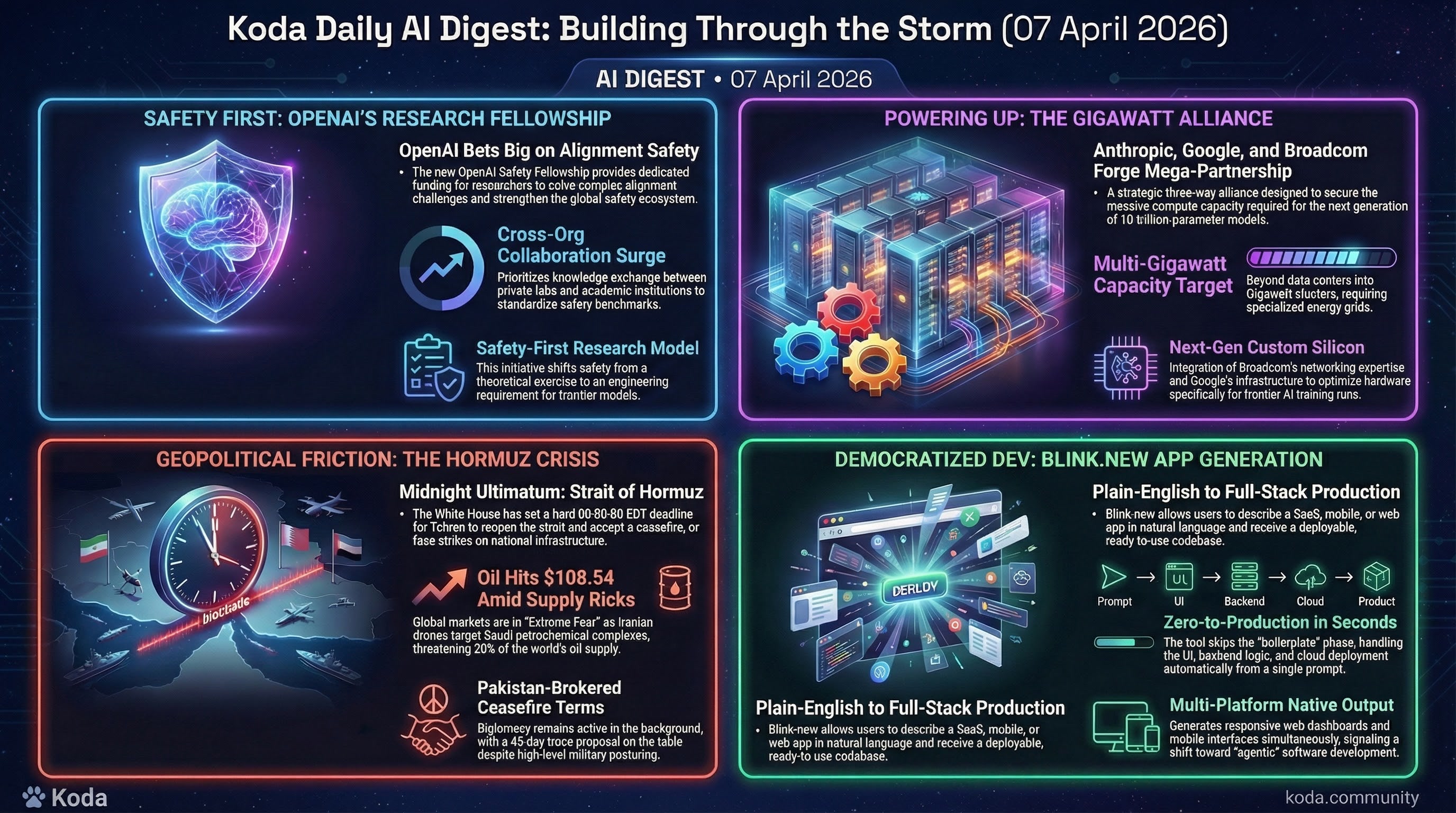
OpenAI announced the OpenAI Safety Fellowship, a new program to support researchers and practitioners working on AI safety. The initiative will foster knowledge exchange and collaborative projects aimed at improving the safety landscape across the AI community. This marks a concrete institutional investment in safety research talent beyond OpenAI's internal teams. Source →
Enterprise
Anthropic Partners Google, Broadcom for Gigawatt-Scale Compute
Anthropic announced a major expansion of its partnership with Google and Broadcom targeting multiple gigawatts of next-generation compute capacity. The deal focuses on large-scale AI processing infrastructure, signaling Anthropic's preparation for training runs far beyond current scale. The partnership aligns with Anthropic's rumored Claude Mythos 5 development, which prediction markets expect before April 30. Source →
Model Release
Microsoft Ships MAI-Transcribe-1 and Voice Models
Microsoft released its MAI model family on April 6, including MAI-Transcribe-1, which the company claims is the most accurate speech-to-text system available at $0.36 per hour. The launch also includes MAI-Voice-1 for speech synthesis and MAI-Image-2 for image generation, all optimized for speed, quality, and safety in human-centric applications. The release further distances Microsoft's in-house AI efforts from its OpenAI dependency. Source →
Enterprise
UBTech Offers $18M Salary for AI Scientist
Chinese robotics company UBTech is offering an annual salary of $approximately 18 million to recruit a top AI scientist, according to Bloomberg. The figure represents an extraordinary escalation in the global talent war for AI researchers, particularly those working at the intersection of embodied intelligence and robotics. UBTech is a leading humanoid robotics firm based in Shenzhen. Source →
Biotech
Meta Ships TRIBE v2 Brain Prediction Model
Meta AI released TRIBE v2, a predictive foundation model trained on human brain responses to visual, auditory, and linguistic stimuli. The model builds on Meta's Algonauts 2025 work and represents a step toward AI systems that can predict and simulate neural activity. The research has implications for brain-computer interfaces and neuroscience-informed model design. Source →
Biotech
Harvard Builds Living Robots With Nervous Systems
Harvard researchers have created microscopic 'neurobots,' living robots equipped with functional nervous systems. Published in IEEE Spectrum, the work represents a convergence of synthetic biology and robotics, producing biological machines capable of sensing and responding to their environment through neural signaling rather than electronic circuits. Source →
Hardware
Meta Details Four MTIA Chips in Two Years
Meta published a detailed technical blog on its MTIA custom silicon program, revealing it has shipped four generations of its in-house AI inference chips in just two years. The chips power AI experiences for billions of users across Meta's platforms, from recommendation systems to generative AI features. The pace underscores Meta's commitment to reducing reliance on NVIDIA for inference workloads. Source →
Open Source
Hugging Face Maps Open Source AI Landscape Spring 2026
Hugging Face published its State of Open Source report for spring 2026, examining shifts in competition, geography, technical trends, and emerging communities across the open-source AI ecosystem. The report arrives as open-weight model releases have accelerated dramatically, with March 2026 alone logging over 30 distinct launches across multiple labs. The analysis provides a benchmark for how open models are closing the gap with proprietary frontier systems. Source →
Benchmark
GPT-5.4 Thinking Hits 75% on OSWorld Benchmark
OpenAI's GPT-5.4 Thinking variant, which uses test-time compute to 'ponder' problems, scored 75.0% on OSWorld-Verified, surpassing human-level performance and improving 27.7 percentage points over GPT-5.2. The model also reduced claim errors by 33% compared to its predecessor. These results position GPT-5.4 Thinking as the current leader in agentic desktop task completion. Source →
Consolidation
Q1 2026 AI Venture Funding Totals $267.2 Billion
Venture funding for AI companies in Q1 2026 reached a record $267.2 billion, dominated by mega-rounds from OpenAI and Anthropic alongside the landmark SpaceX acquisition of xAI. The figure reflects a systemic industrialization of the AI sector, with capital flowing toward agentic systems and inference infrastructure. The pace of investment has fundamentally altered the competitive dynamics of the industry. Source →
Trend
Industry Release Cadence Now Averages 72 Hours
The AI model release cycle has compressed to an average of one major launch every 72 hours, according to multiple tracking sources. March 2026 saw 12 models from six labs in a single week, while April has already delivered releases from Microsoft, Mistral, Anthropic, and Google in its first seven days. Developers now face a monthly, not annual, model selection problem, with specialized models outperforming generalists on narrow tasks by 8 to 14 percentage points. Source →